Human Intelligence at Scale, Across Every AI Pipeline
140+ trained raters on a managed floor in Nairobi. From LLM evaluation and RLHF labeling to 3D LiDAR annotation and robotics data. One team, one quality standard, every service.
Managed Annotation for Teams That Cannot Afford to Get It Wrong
TechAI Remote is not a marketplace. Every project runs on a trained managed floor, through a 4-layer QA pipeline, before a single item reaches you. We deliver finished, QA-verified labels across every service — not another platform to supervise.
Our primary lane is LLM evaluation and human judgment work. Our second lane is 3D LiDAR and computer vision annotation for autonomous systems and robotics. Both lanes share the same rater pool, the same quality infrastructure, and the same delivery standard.
LLM Evaluation & Human Judgment
Every LLM that reaches production had humans behind it. Rating responses, flagging failures, teaching the model what good looks like. We are that layer. Rubric-trained raters, 4-layer QA, delivered at scale.
RLHF labeling · Agent benchmarking · Audio CSAT · Preference ranking · Red-team eval · Multilingual EN/FR/ZH/DE
View Full LLM Eval Service →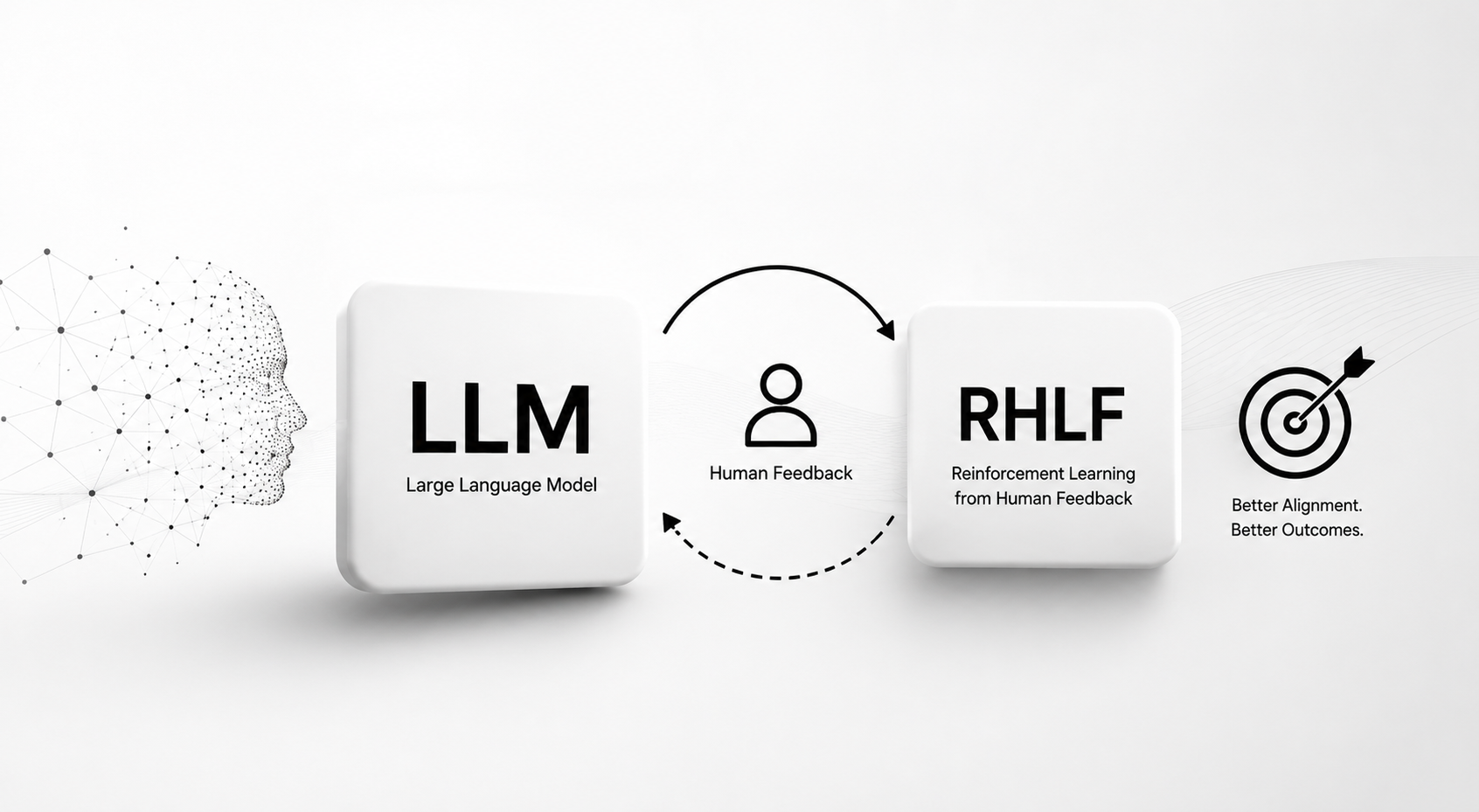
RLHF & Preference Labeling
Pairwise response ranking for LLM fine-tuning. Raters trained on your rubric specifically — not generic crowd guidelines. Full audit trails per batch.
Agent Benchmark Evaluation
Human scoring of multi-step task completion, tool use accuracy, and decision quality where automated scoring misses real failures.
Audio & CSAT Scoring
Human scoring of AI-generated or recorded audio for naturalness, accuracy, and customer satisfaction. Calibrated raters, structured rubrics.
LLM Output Labeling
Large-scale annotation of model outputs for quality, safety, factual accuracy, and instruction-following at volume.
Multilingual Evaluation
English-core with French, Chinese (Mandarin), and German capacity. EU AI Act Article 53 enforcement is August 2026 — the multilingual eval window is now.
Red-Team Adversarial Testing
Structured adversarial testing — hallucination, refusal failures, instruction drift. Per-session failure taxonomy reporting included.
The managed floor difference: TechAI Remote is not a marketplace. Every rater is trained on your specific rubric, reviewed by a lead auditor, and held to 4-layer QA before a single item reaches you. A crowd gives you volume. A managed floor gives you quality you can ship on.
3D LiDAR & Sensor Fusion Annotation
Production-grade 3D annotation for perception teams building autonomous vehicles, mobile robots, and ADAS systems. We handle the full pipeline: cuboid annotation, segmentation, multi-sensor alignment, and temporal tracking — delivered as QA-verified ground truth in your format.
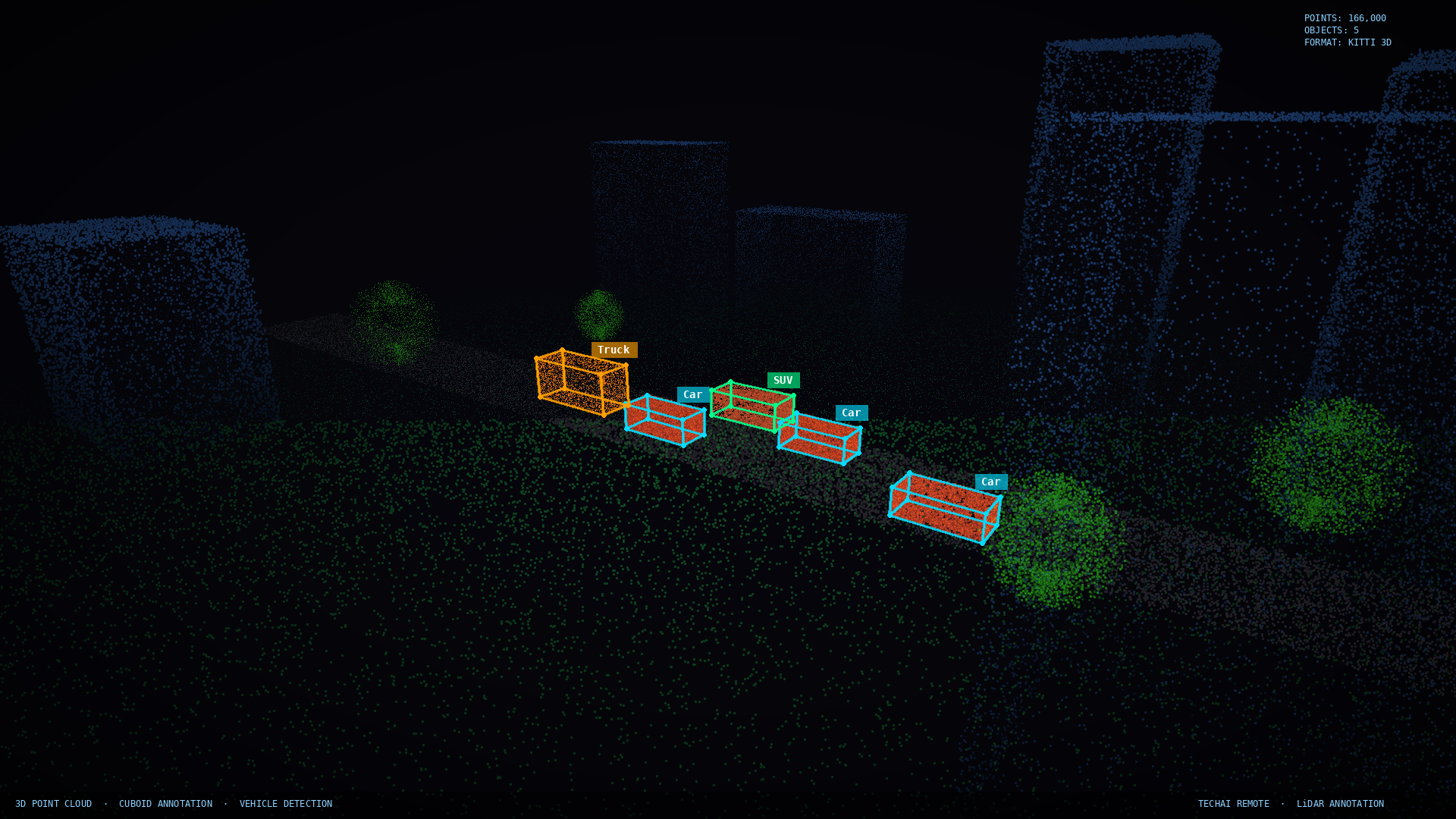
3D cuboid annotation on LiDAR point cloud — vehicle detection with class labels and orientation
3D Cuboid Annotation
Volumetric bounding boxes with position, orientation, and dimensions. Handles vehicles, pedestrians, cyclists, trucks, and custom object classes.
Multi-Sensor Fusion
Synchronized annotation across LiDAR, camera, and radar with calibration-based projection. 3D-to-2D label transfer and cross-modal alignment verification.
Point Cloud Segmentation
Per-point semantic labeling across 20+ object classes. Instance segmentation with unique object IDs, ground plane, and lane marking annotation.
Temporal Tracking
Consistent object ID assignment across sequential frames. Maintains identity through occlusion events, lane changes, and scene transitions.
HD Map Annotation
3D polyline annotation for lane markings, road boundaries, and infrastructure for autonomous navigation HD map pipelines.
Attribute Annotation
Occlusion state, truncation level, movement state, and custom attributes per object — critical metadata for robust perception models.
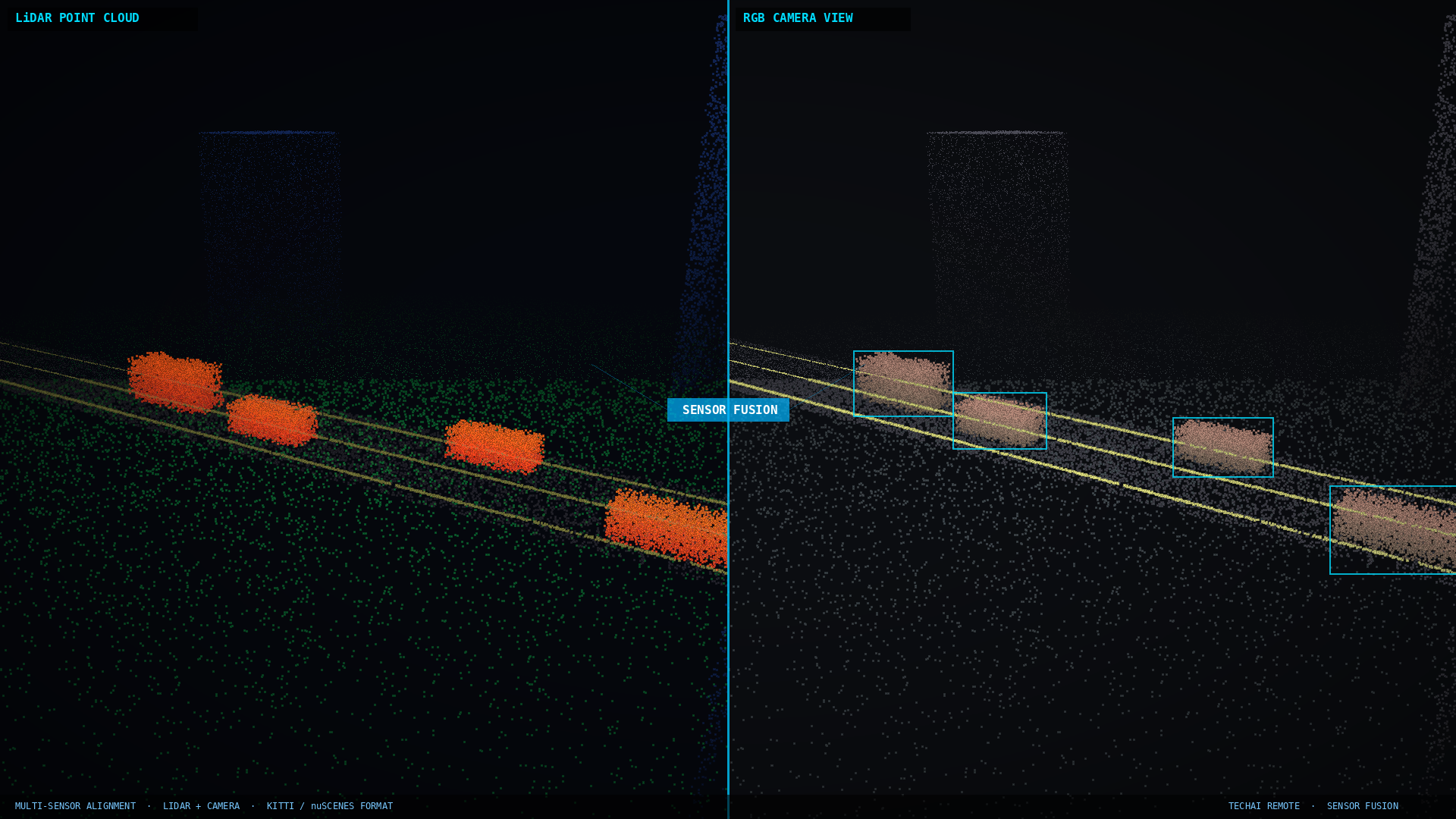
Multi-sensor fusion: LiDAR point cloud aligned with RGB camera — cross-modal annotation with nuScenes/KITTI export
Why 3D annotation is irreplaceable: Auto-labeling achieves 94% accuracy on common 2D objects but collapses below 20% on rare classes in 3D point clouds. At 50+ meters, objects may be represented by a handful of LiDAR points. Occlusion, sensor noise, and varying density make 3D annotation a fundamentally human task for production-quality output.
Autonomous Vehicle Edge Case Annotation
Over 98% of public annotated driving data was collected under clear, well-lit conditions. The safety-critical events cluster in the remaining 2% — and that is where perception models fail. We specialize in the scenarios that determine whether your AV system is safe for deployment.
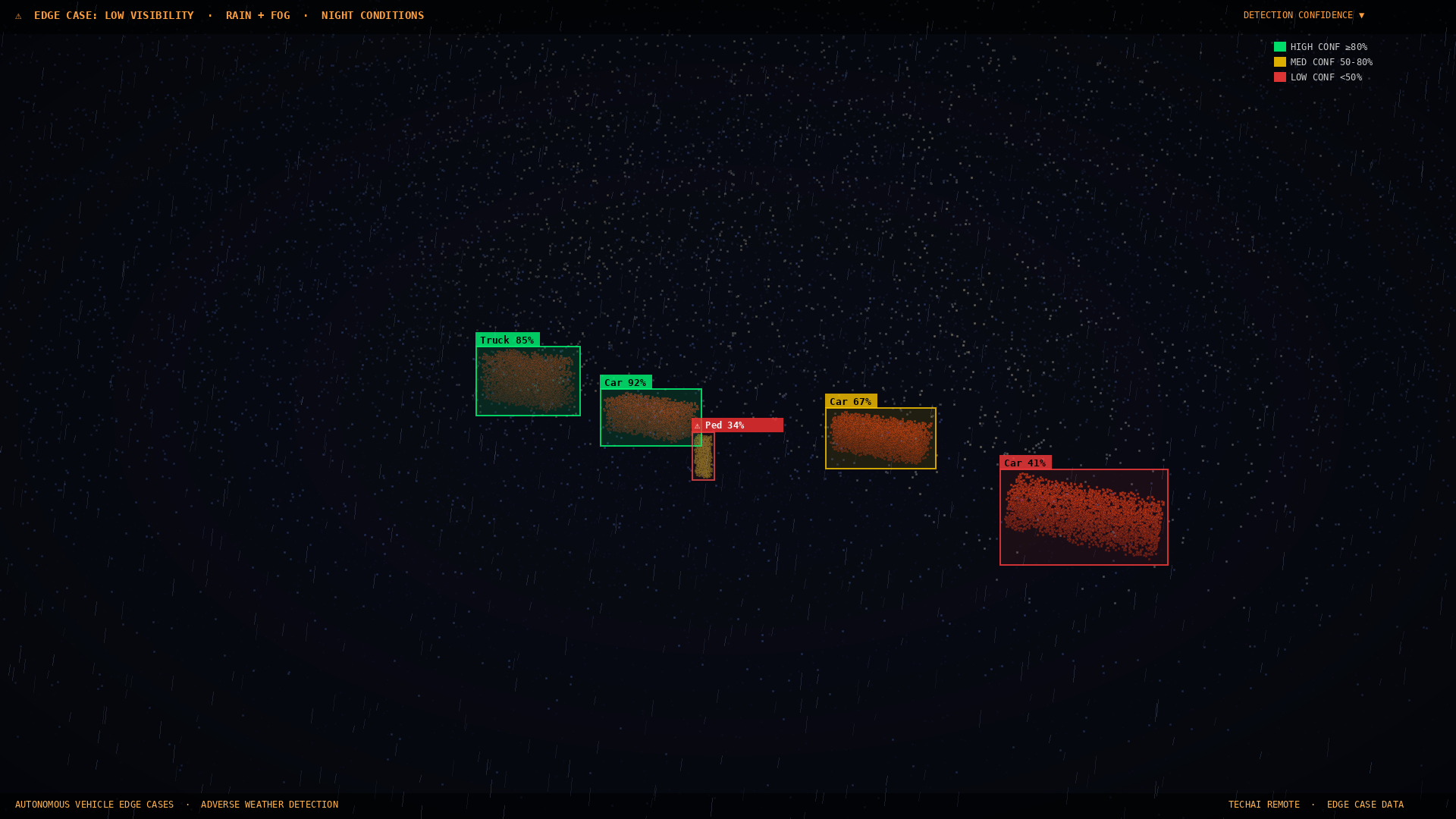
Edge case annotation in adverse weather — rain, fog, and low-light conditions that auto-labeling cannot handle
Environmental Challenges
- Adverse Weather: Rain, fog, snow reducing LiDAR range by up to 50%
- Low Light: Nighttime, dusk, tunnel transitions, glare from oncoming headlights
- Sensor Artifacts: Phantom points from reflective surfaces, missing returns from dark objects
- Range Degradation: Sparse point density at 50+ meters where objects become a handful of points
Scenario Complexity
- Occluded Road Users: Pedestrians partially hidden behind vehicles, cyclists emerging from blind spots
- Rare Object Classes: Construction equipment, animals, debris, overturned vehicles, emergency scenes
- Ambiguous Scenarios: Jaywalking intent, vehicle door opening, cyclist hand signals
- Multi-Frame Reasoning: Temporal consistency through occlusion events and scene transitions
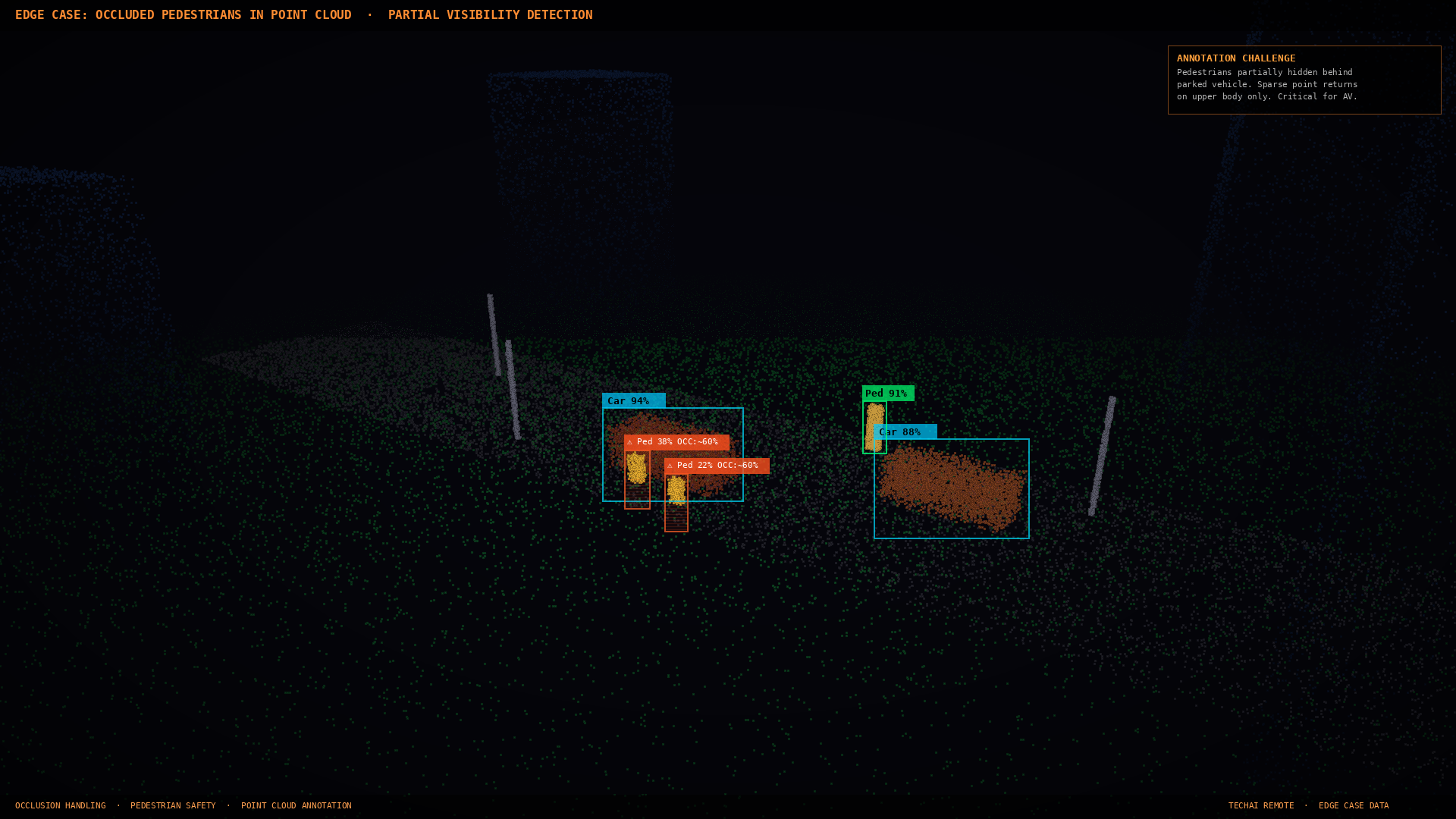
Occluded pedestrian annotation — partial visibility detection with occlusion percentage labels, critical for AV safety validation
The safety math: A 99% model accuracy rate sounds impressive until you consider that across 10,000 miles with 100 edge cases, 1% failure means one unhandled scenario that could be fatal. The edge cases are not a nice-to-have — they are the entire safety case.
Robotics & 6DoF Pose Annotation
Training data for robot manipulation, grasping, and navigation systems. Robotics requires annotation that goes beyond bounding boxes — your model needs to understand object position and orientation across six degrees of freedom, grasp affordances, and deformable objects in cluttered environments.
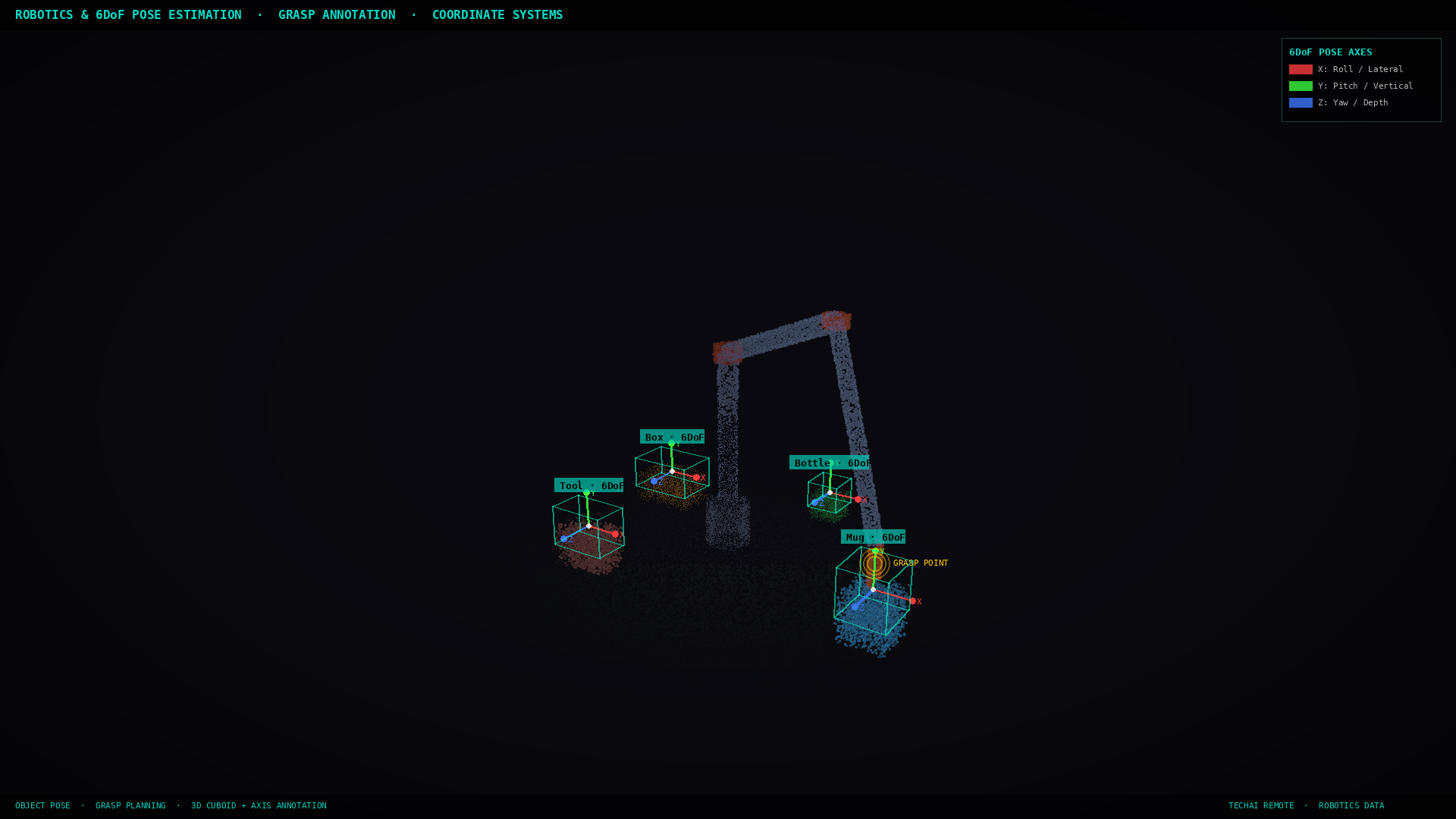
6DoF pose annotation with coordinate axes, grasp point labeling, and 3D cuboid bounding boxes
6DoF Pose Estimation
Position and orientation labeling across six parameters with sub-centimeter accuracy. Full coordinate system annotation for each object.
Grasp Annotation
Grasp point, approach vector, and grip type labeling. Task-aware annotation — grasping by the handle to cut versus to hand over.
Deformable Objects
Annotation for cloth, food, cables, and other objects with no standard pose definition. Handles the effectively infinite configuration space of soft materials.
Scene Understanding
Spatial relationship annotation, obstacle mapping, and navigation path labeling for mobile robots in unstructured environments.
Sim-to-Real Bridging
Domain gap labeling, texture and lighting variation, and real-world edge cases missing from synthetic datasets.
Teleoperation Data
Trajectory annotation for learning-from-demonstration pipelines. Action segmentation, keyframe labeling, and task completion verification for VLA training.
Market timing: Robotics VC funding exceeded $12B in 2025. Figure AI, Physical Intelligence, Skild AI, and Agility Robotics are all scaling — and they all need annotated 3D perception data. This is where autonomous vehicle annotation was in 2016 to 2018, before it became a billion-dollar segment.
Image & Video Annotation
Comprehensive 2D annotation for computer vision applications. This is where we built our reputation — handling complex edge cases in license plate recognition, CCTV tracking, and warehouse robotics before expanding into 3D. The same quality infrastructure delivers consistent results on 2D tasks.
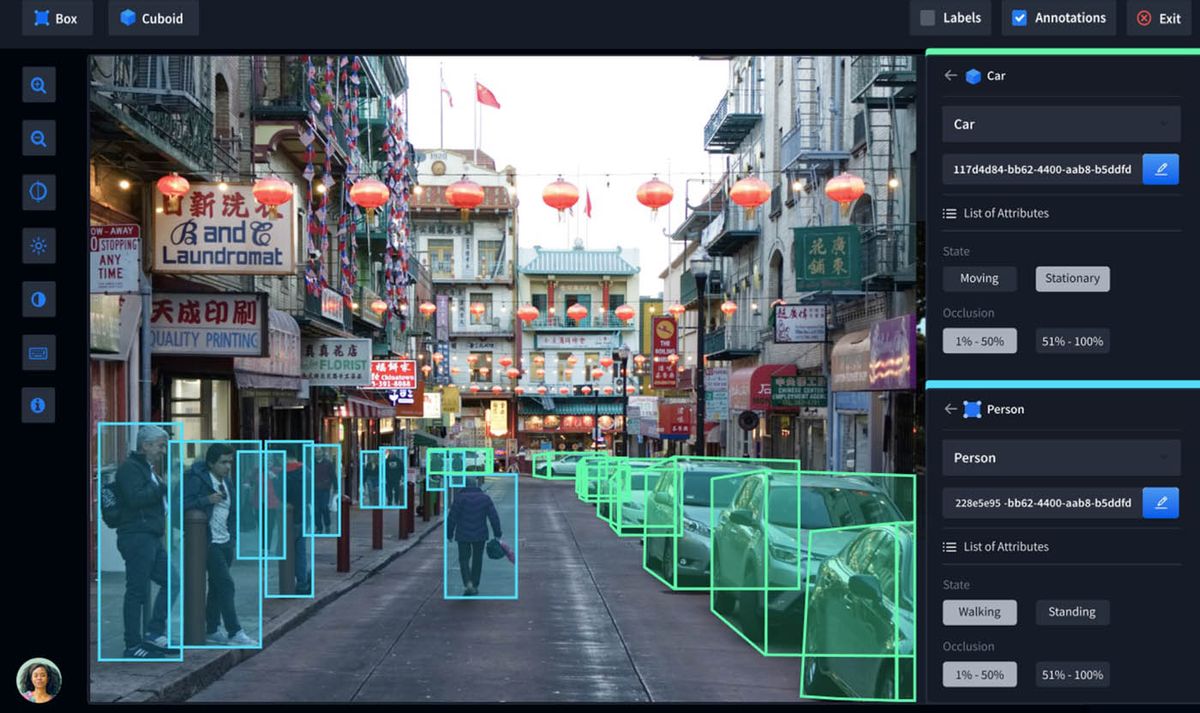
Professional 2D annotation workflow — bounding box detection, polygon segmentation, and multi-class labeling
Object Detection
2D bounding boxes with class labeling for crowded scenes and overlapping objects. Built for the edge cases that degrade model performance.
Polygon & Semantic Segmentation
Pixel-precise boundary tracing and dense scene parsing. Instance segmentation with unique object IDs across complex environments.
Video Object Tracking
Persistent ID assignment across frames through occlusions and scene transitions. Consistent identity across hundreds of frames.
Keypoint Annotation
Pose estimation and skeletal tracking for human and animal motion analysis. COCO-standard 17-point and custom configurations.
Multi-Label Classification
Attribute tagging with hierarchical categories and complex taxonomies. Built for datasets where context determines the label.
Edge Case Specialization
Weather-obscured objects, low-light conditions, cluttered scenes, motion blur. Where auto-labeling collapses and human judgment is irreplaceable.
Five Stages. No Exceptions.
Every annotation project follows our multi-stage QA workflow regardless of service type. For 3D LiDAR work, IoU validation, position accuracy measurement, and orientation alignment checks are added on top.
Annotator Training & Calibration
Custom guidelines and training sessions tailored to your data, taxonomy, and edge case definitions. 3D annotators complete 120+ hours of dedicated training on point cloud spatial reasoning before production. Must achieve 95%+ accuracy on calibration tasks to qualify.
Production Annotation
Experienced annotators work on assigned batches with real-time spot-checking and automated validation rules. For 3D work, cuboid dimensions, orientation, and position are cross-validated against sensor data during production.
Peer Review
A second annotator reviews 20-30% of all annotations. For 3D tasks, peer review checks IoU overlap, temporal consistency across frames, and attribute accuracy. Discrepancies flagged for consensus resolution before moving forward.
QA Lead Review
Our QA team performs final validation on every batch — edge case handling, guideline adherence, inter-annotator consistency, and format compliance. For 3D: position accuracy within 10-30cm and orientation accuracy within 5-10 degrees.
Client Feedback Loop
We incorporate your feedback on delivered batches to refine guidelines and improve accuracy. Edge case definitions built from your data create a quality floor that compounds over time.
Your Data Stays Yours
Autonomous vehicle, robotics, and AI evaluation data is safety-critical IP. We treat it accordingly. Self-hosted infrastructure, NDA on every project, and no competing interests with your data.
NDA Standard
Non-disclosure agreements on every project before any data transfer. No exceptions, no opt-out.
ISO 27001 In-Flight
Information security management system certification in progress, target Q4 2026.
SOC 2 Type I Roadmap
Security and availability controls certification roadmap in place. Type I observation period beginning.
GDPR Compliance
Data processing agreements for European clients. AV data containing PII handled under GDPR protocols.
Self-Hosted Infrastructure
Data never leaves our server without your explicit export. No third-party SaaS between you and your data.
Conflict-Free Independence
No ties to any AI lab, platform, or competing technology company. Your IP, zero competing interests.
Independence matters: In a market where the largest annotation provider lost its neutrality through acquisition, TechAI Remote remains a fully independent provider with no ties to any AI lab or platform. Your data, your IP, zero competing interests — on every project, every time.
Start With a Free Pilot
Every engagement starts with a free pilot — whether it is RLHF preference pairs, 3D LiDAR frames, or 2D annotation. You see the quality before any contract is signed.