Your Perception Model Is Only as Good as Your Training Data
140+ trained annotators delivering production-grade 3D LiDAR, sensor fusion, and edge case annotation for the autonomous systems that cannot afford to get it wrong.
Auto-Labeling Works Great. Until It Doesn’t.
Your auto-labeling pipeline handles 95% of frames without issue. Clear weather, standard objects, dense point clouds. The remaining 5% — rain-soaked intersections, a pedestrian stepping from behind a bus, construction debris at 60 meters — is where your perception model gets tested. And where it fails.
That 5% is also where safety-critical decisions happen. It is what regulatory bodies focus on. It is what determines whether your system ships or stalls in validation. Auto-labeling collapses on these frames because edge cases are, by definition, outside the distribution it was trained on.
The math is brutal: A 99% accurate model across 10,000 edge cases means 100 failures. In autonomous driving, each failure is a potential safety incident. In robotics, each failure is a dropped object, a missed grasp, a collision. The hard 5% is not a nice-to-have — it is the entire safety and performance case.
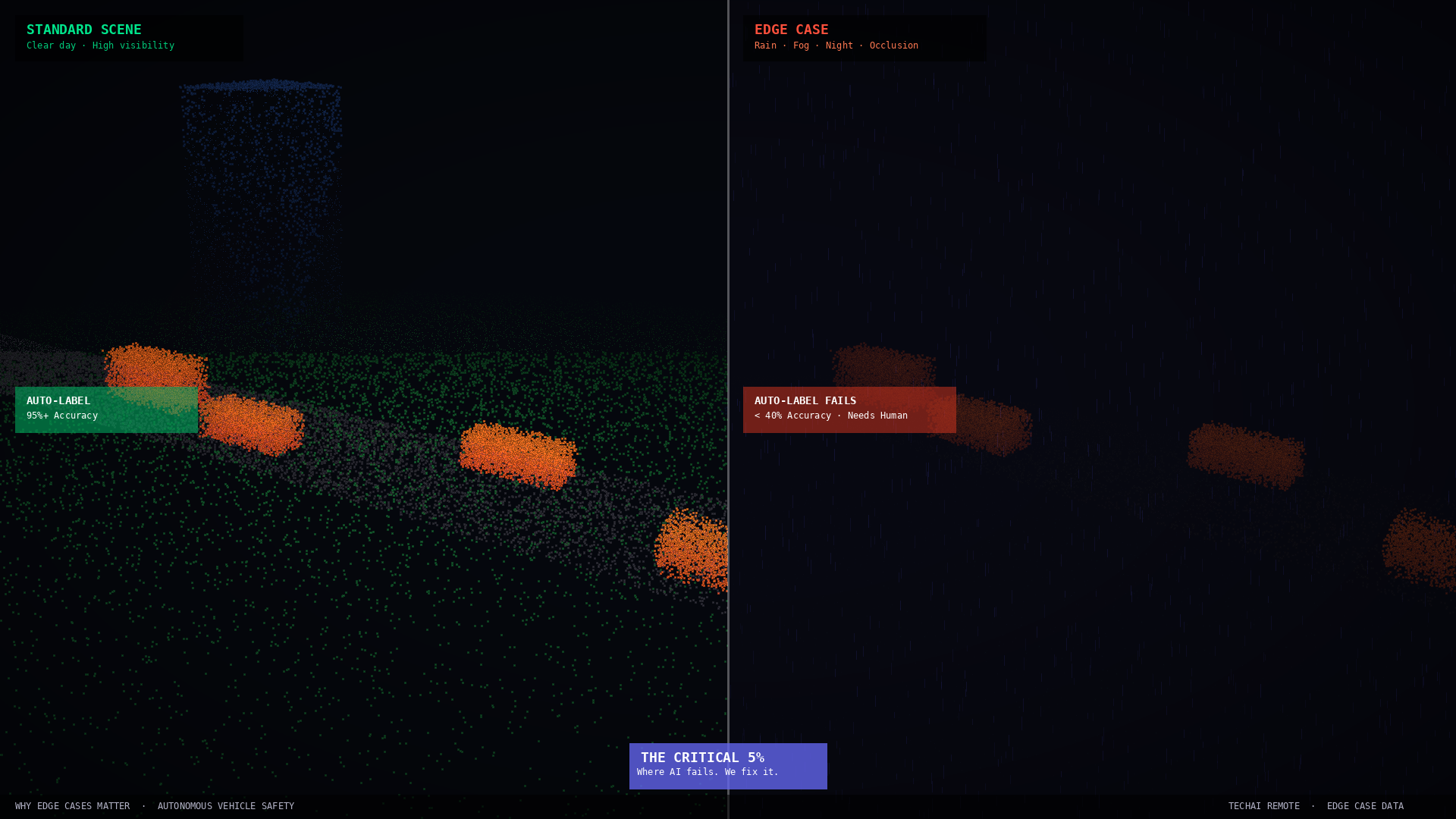
Left: standard conditions, 96%+ auto-label accuracy. Right: edge case — auto-labeling drops below 20%, requiring expert human annotation.
3D LiDAR & Sensor Fusion Annotation
We deliver finished, QA-verified 3D labels — not a platform for you to manage. Your perception engineers stay focused on model development while we handle the annotation pipeline end-to-end: cuboids, segmentation, multi-sensor fusion, and temporal tracking across sequential frames.
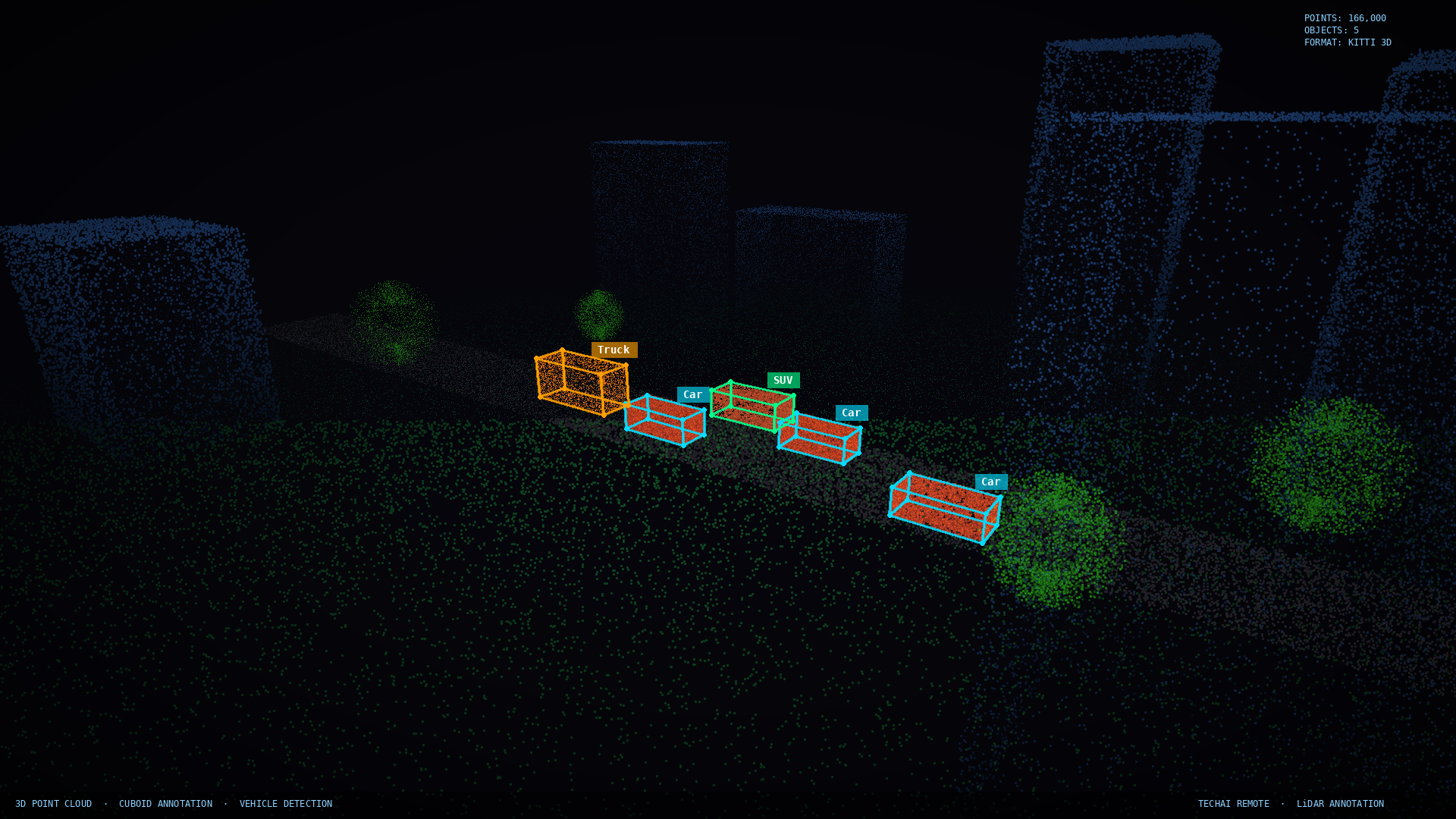
3D cuboid annotation on LiDAR point cloud — vehicle detection with class labels, orientation, and dimensions in KITTI 3D format
3D Cuboid Annotation
Volumetric bounding boxes with position, orientation, and dimensions. Vehicles, pedestrians, cyclists, trucks, and custom object classes across all point cloud densities.
Multi-Sensor Fusion
Synchronized annotation across LiDAR, camera, and radar. Calibration-based 3D-to-2D projection and cross-modal alignment verification per frame.
Point Cloud Segmentation
Per-point semantic and instance labeling across 20+ classes. Ground plane, drivable area, lane markings, and HD map annotation included.
Temporal Tracking
Consistent object ID assignment across sequential frames. Identity maintained through occlusion events, lane changes, and scene transitions.
HD Map Annotation
3D polyline annotation for lane markings, road boundaries, and infrastructure for autonomous navigation HD map pipelines.
Attribute Annotation
Occlusion state, truncation level, movement state, and custom attributes per object — critical metadata for robust perception model training.
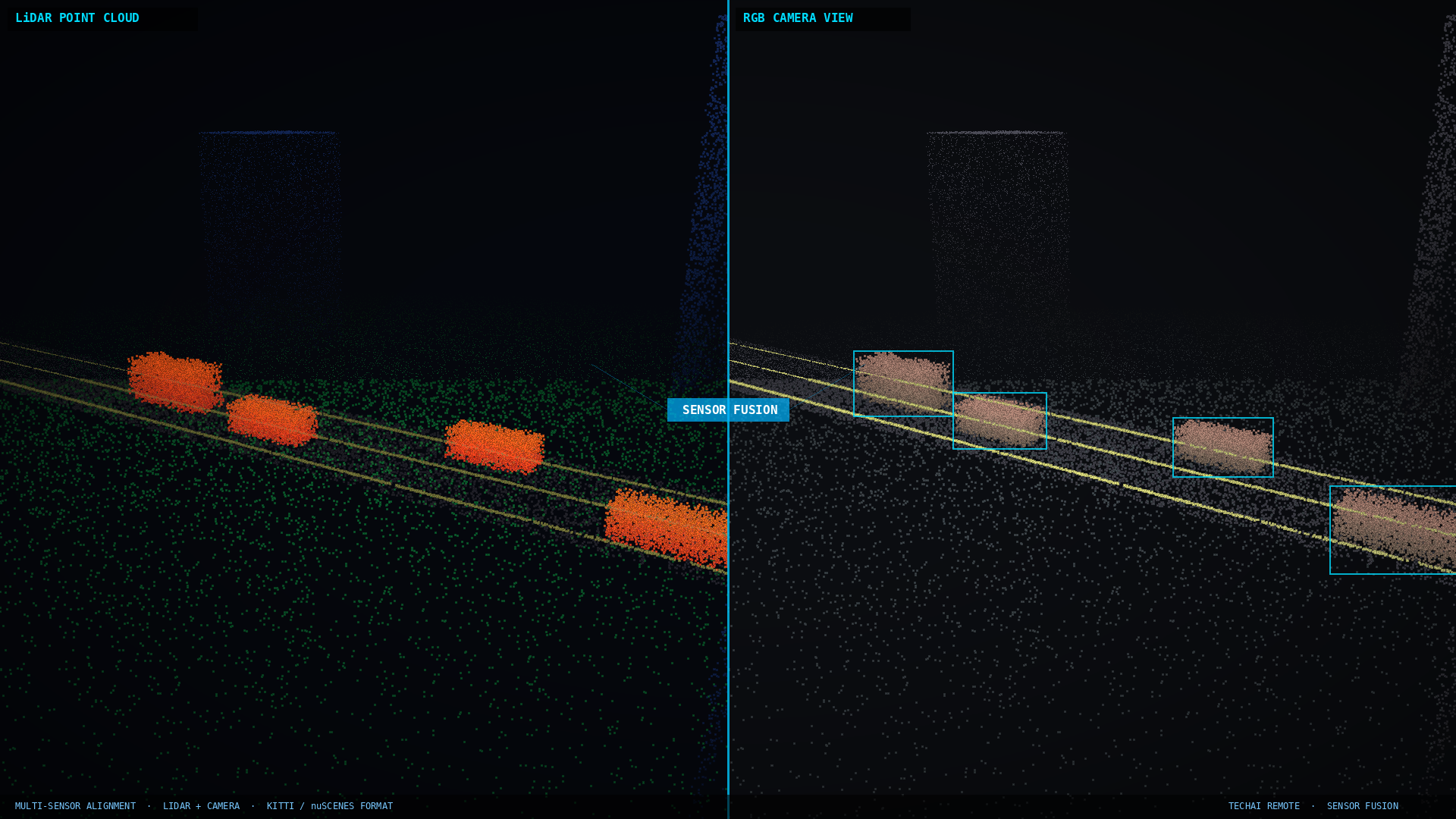
Multi-sensor fusion: LiDAR point cloud aligned with RGB camera — cross-modal annotation exported in nuScenes and KITTI formats
Autonomous Vehicle Edge Case Annotation
Over 98% of public annotated driving data was collected under clear, well-lit conditions. We annotate the other 2% — the scenarios that determine whether your AV system passes validation: adverse weather, occluded road users, rare objects, and ambiguous scenes that require human reasoning to label correctly.
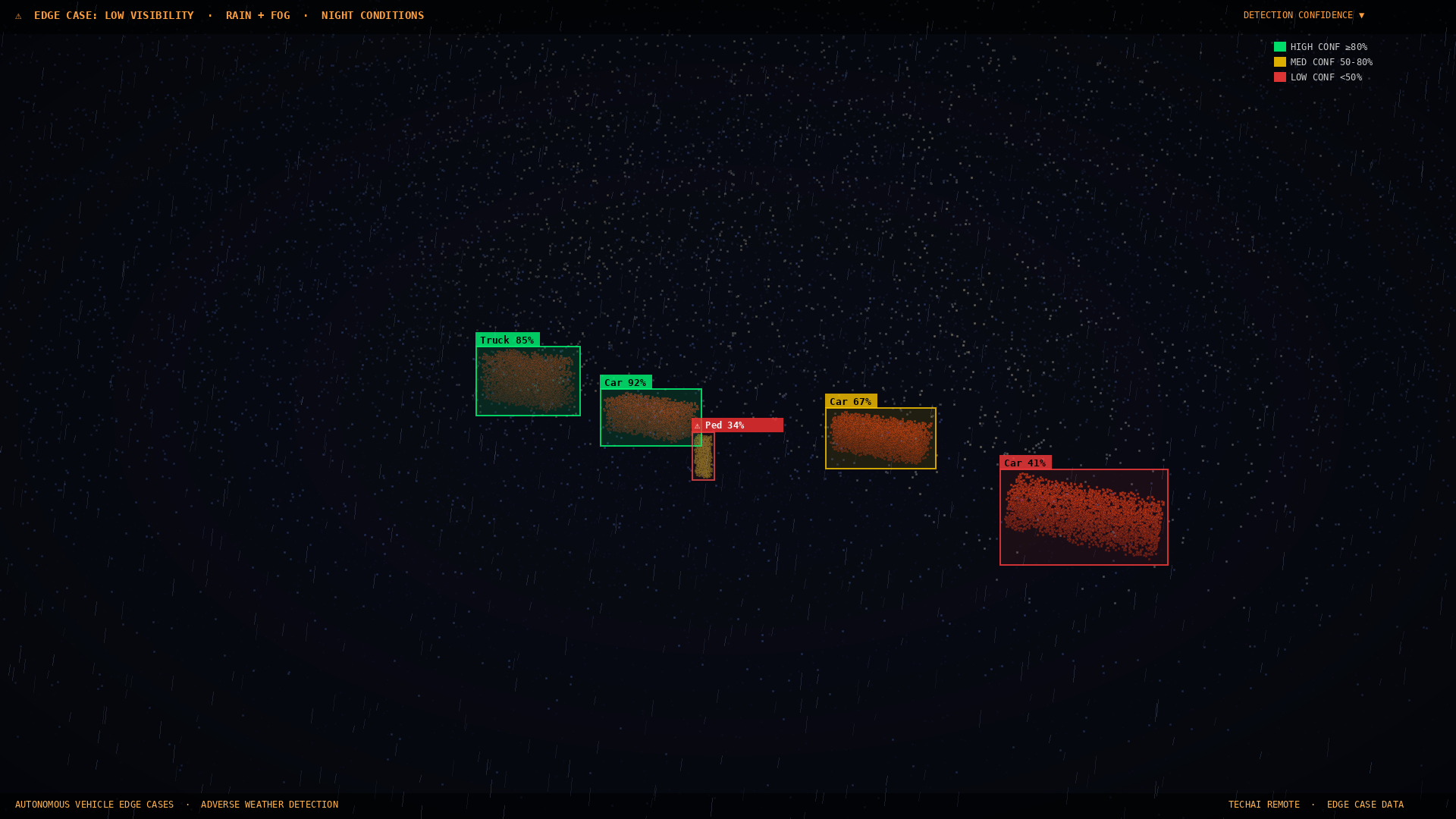
Detection confidence degrades sharply in adverse conditions — expert human annotation fills the gap auto-labeling leaves
Environmental Challenges
- Adverse Weather: Rain, fog, snow reducing LiDAR range by up to 50%
- Low Light: Night, dusk, tunnel transitions, and glare from oncoming headlights
- Sensor Artifacts: Phantom points from reflective surfaces, missing returns from dark objects
- Long Range: Sparse density at 50+ meters where objects are a handful of points
Scenario Complexity
- Occlusions: Pedestrians behind vehicles, cyclists emerging from blind spots
- Rare Classes: Construction equipment, animals, debris, emergency scenes
- Ambiguous Intent: Jaywalking, door opening, cyclist hand signals
- Temporal Reasoning: Multi-frame consistency through occlusion events
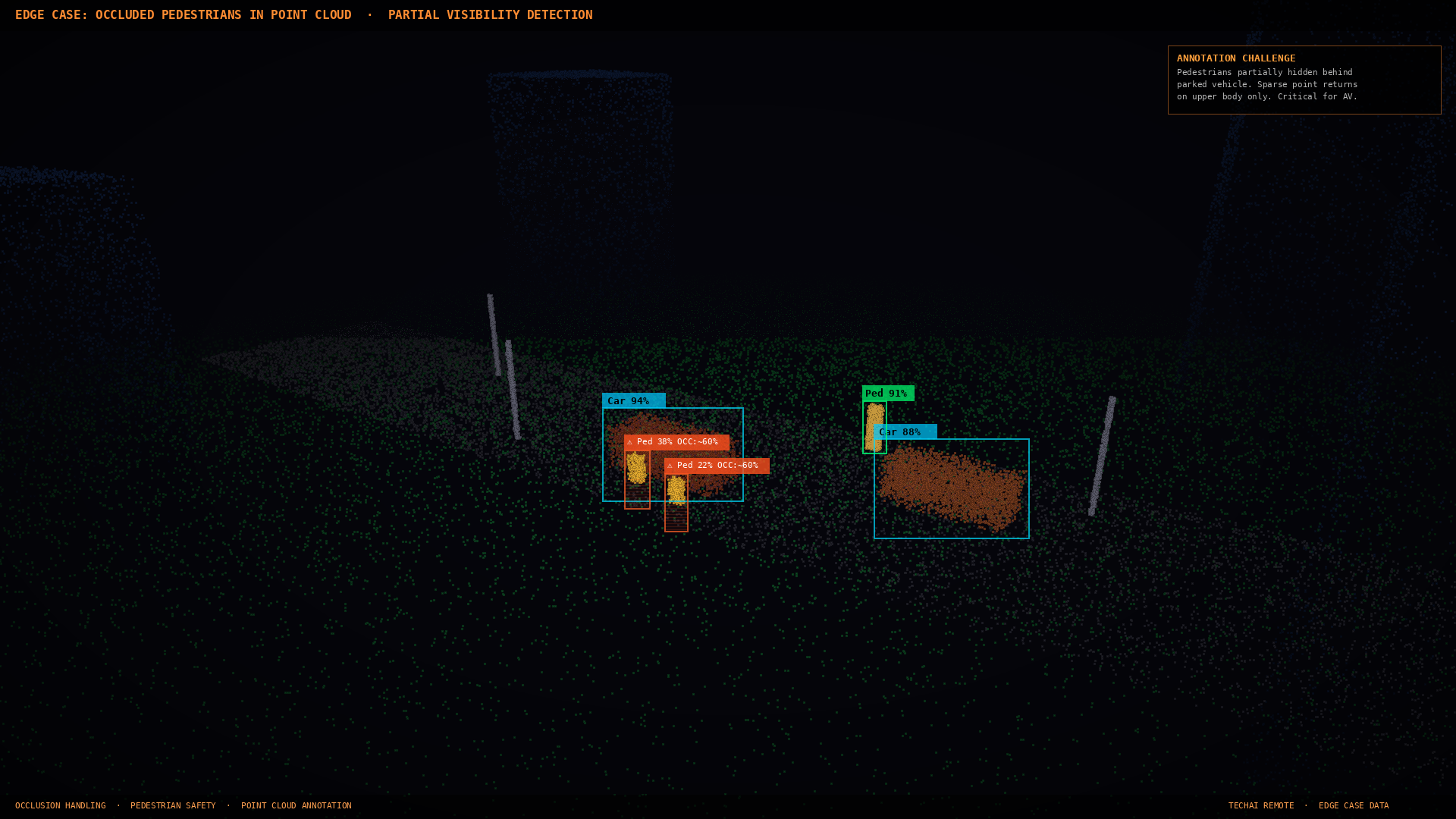
Occluded pedestrian annotation with occlusion percentage labels — critical for AV safety validation pipelines
Annotation in Action
Real-time 3D annotation on highway driving scenes — cuboid tracking, object classification, and detection overlays across live traffic sequences.
Annotated highway scene with 3D cuboid tracking, object classification, and detection confidence overlays
The safety math: A 99% model accuracy rate sounds impressive until you consider that across 10,000 edge cases, 1% failure means 100 unhandled scenarios — each a potential safety incident. The edge cases are not a nice-to-have. They are the entire safety case.
Robotics & 6DoF Pose Annotation
Robotics perception needs annotation that goes far beyond bounding boxes. Your model needs to understand object position and orientation in six degrees of freedom, grasp affordances, deformable object states, and spatial relationships in cluttered, unstructured environments.
We provide the training data that bridges the sim-to-real gap — the specific labeled scenarios where simulated datasets fall short and real-world annotations are irreplaceable.
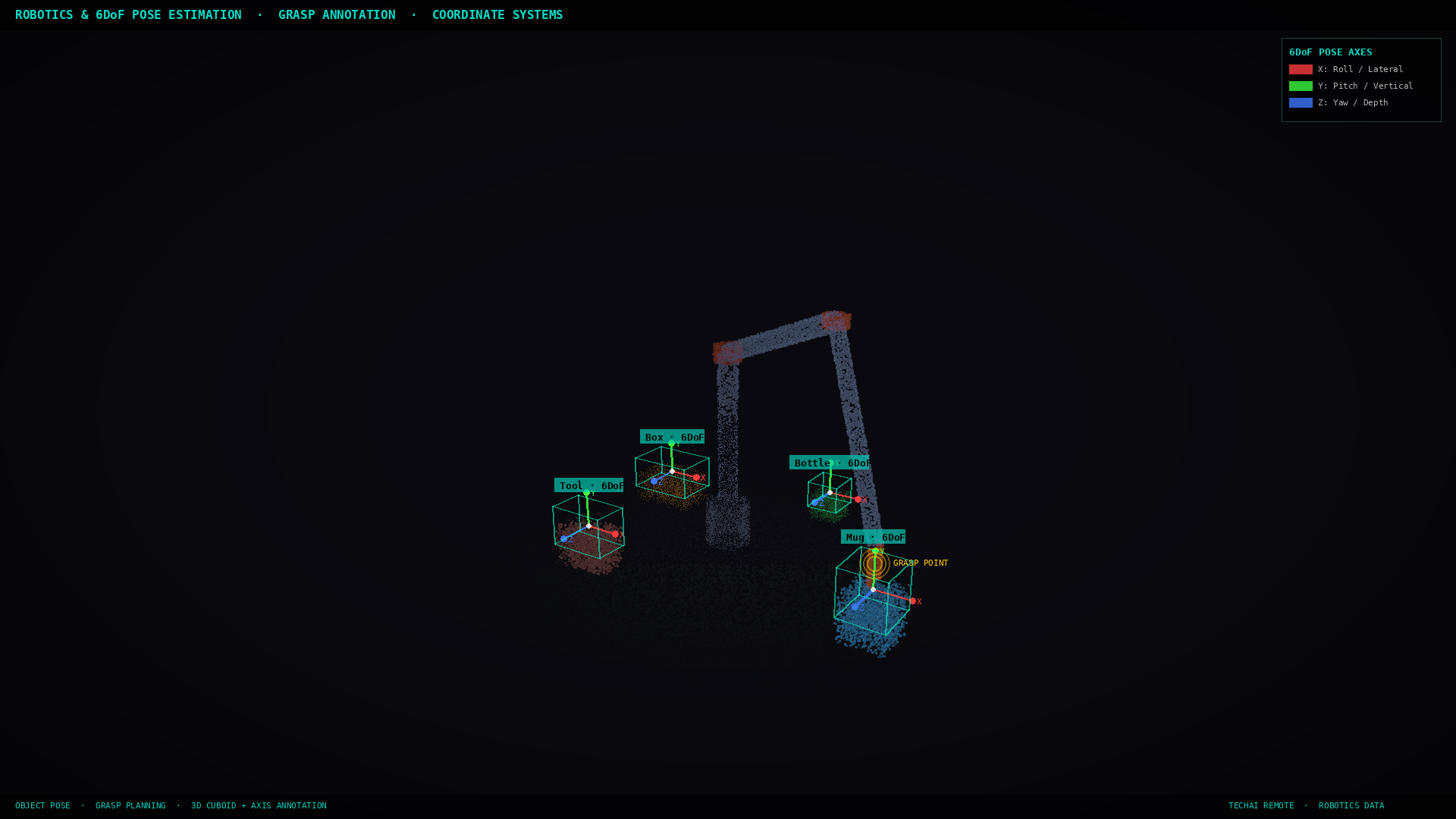
6DoF pose annotation with RGB coordinate axes, grasp point labeling, and 3D cuboids for robotic manipulation tasks
6DoF Pose Estimation
Position and orientation across six parameters with sub-centimeter accuracy. Full coordinate system annotation for each object in scene.
Grasp Annotation
Grasp point, approach vector, and grip type labeling. Task-aware — how to grasp a knife to cut versus how to hand it to someone.
Deformable Objects
Cloth, food, cables — objects with no rigid pose definition. Handles the infinite configuration space of soft materials in real environments.
Scene Understanding
Spatial relationship annotation, obstacle mapping, and navigation path labeling for mobile robots in unstructured environments.
Sim-to-Real Bridging
Domain gap labeling, texture and lighting variation, and real-world edge cases missing from synthetic datasets.
Teleoperation & VLA Data
Trajectory annotation for learning-from-demonstration. Action segmentation, keyframe labeling, and task completion for VLA model training.
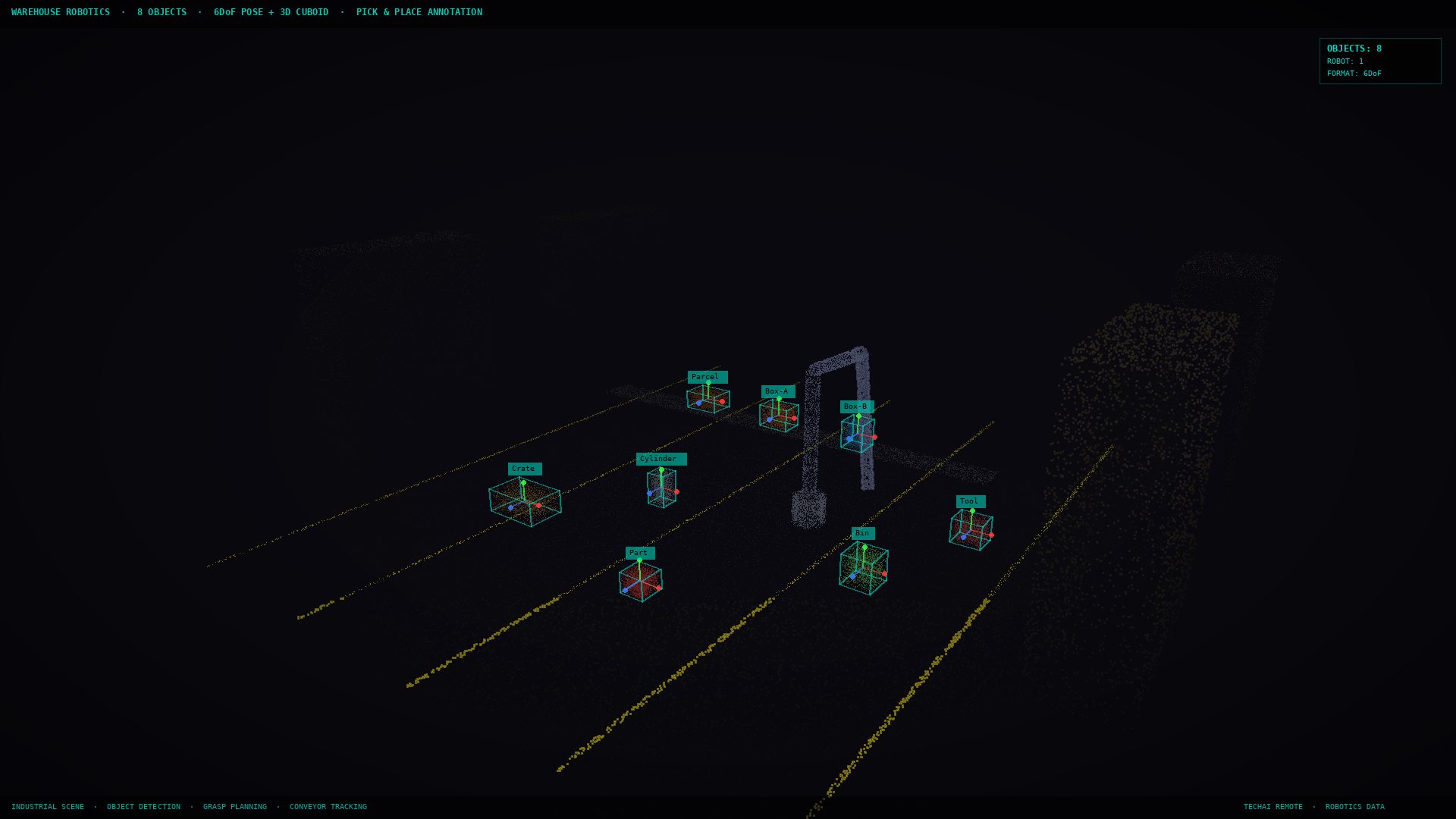
Industrial warehouse annotation at scale — multiple object classes with 6DoF pose, grasp points, and spatial relationship labels
Market timing: Robotics VC funding exceeded $12B in 2025. Figure AI, Physical Intelligence, Skild AI, Agility Robotics, and dozens of YC-backed startups are all scaling — and they all need annotated 3D perception data. This is where autonomous vehicle annotation was in 2016 before it became a billion-dollar segment.
From Raw Data to Production-Grade Labels
Every project follows our multi-stage pipeline built for 3D annotation quality. Your data goes in raw and comes out QA-verified, format-compliant, and ready for training.
Ingest & Scope
We review your data, taxonomy, and edge case definitions. Custom guidelines built for your perception stack.
Team Training
Annotators complete 120+ hours of 3D training. Must hit 95%+ on calibration tasks before production access.
Production Annotation
Experienced annotators work batches with real-time spot-checking. Cuboids cross-validated against sensor data.
Multi-Stage QA
Peer review, QA lead validation, IoU checks, and position/orientation accuracy verification. 98.5% guaranteed.
Deliver & Iterate
Labels in your format. Feedback incorporated. Edge case definitions compound quality over time.
Results That Ship
We built our reputation on the complex annotation work others could not handle. Here is what that looks like in production.
Start With a Free 500-Frame Pilot
48-hour delivery. Full QA report with IoU scores and accuracy metrics. No commitment required — you see the quality before spending anything.