Polygon Segmentation — Industrial & Automotive
1,000 images with pixel-precise polygon instance segmentation for industrial and automotive applications. Subcontracted project delivered under NDA on self-hosted CVAT.
The Challenge
When bounding boxes aren’t enough, polygon segmentation delivers pixel-level object boundaries. Instance segmentation requires annotators to trace the exact contour of every object — distinguishing individual instances even when they overlap, capturing irregular shapes that rectangles can’t represent, and maintaining boundary precision across hundreds of vertices per object.
TechAI Remote was subcontracted to deliver polygon instance segmentation across 1,000 images spanning industrial and automotive domains. The client’s identity is protected under NDA. Every annotation was produced on our self-hosted CVAT instance with full three-layer QA, delivered in client-specified export formats.
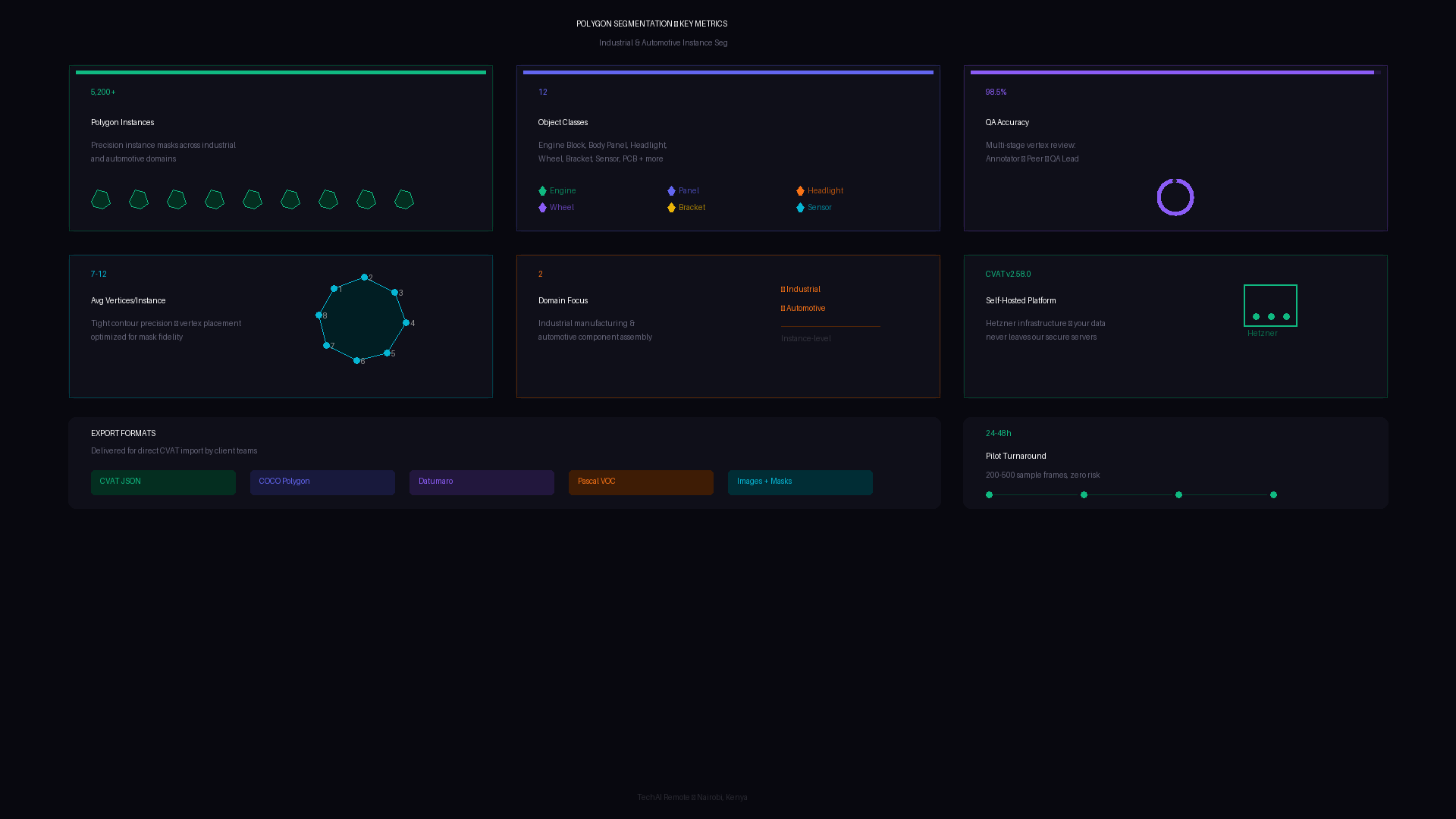
Project metrics: 1,000 images annotated with pixel-precise polygon instance segmentation across industrial and automotive domains
Technical SpecificationsAnnotation Details
Why Polygons Over Bounding Boxes
Bounding boxes include significant background pixels around irregular objects — a person’s silhouette, a car’s contour, or an industrial component’s shape. Polygon segmentation traces the actual object boundary, giving models pixel-accurate training data. This is critical for applications where background contamination in labels directly degrades model performance.
Annotation Approach
| Aspect | Detail |
|---|---|
| Type | Instance segmentation (individual object polygons) |
| Precision | Pixel-level boundary tracing |
| Vertices | 50–300+ points per complex object |
| Overlap Handling | Separate polygon per instance, even when overlapping |
| Domains | Industrial components & automotive scenes |
Infrastructure
| Component | Detail |
|---|---|
| Platform | CVAT v2.58.0 (self-hosted) |
| Server | Hetzner dedicated server |
| Deployment | Docker with SSL |
| Data Security | Data never leaves our server |
| Client | NDA-protected |
Export Formats
| Format | Use Case |
|---|---|
| COCO JSON | Instance segmentation training |
| Pascal VOC | Segmentation masks |
| CVAT JSON | Client CVAT import |
| Segmentation Masks | PNG mask export per class |
Annotation in Production
Real screenshots from our self-hosted CVAT instance showing polygon instance segmentation. Each image demonstrates the precision of boundary tracing — individual polygons per object instance with class-specific color coding and the CVAT objects panel showing label assignments.
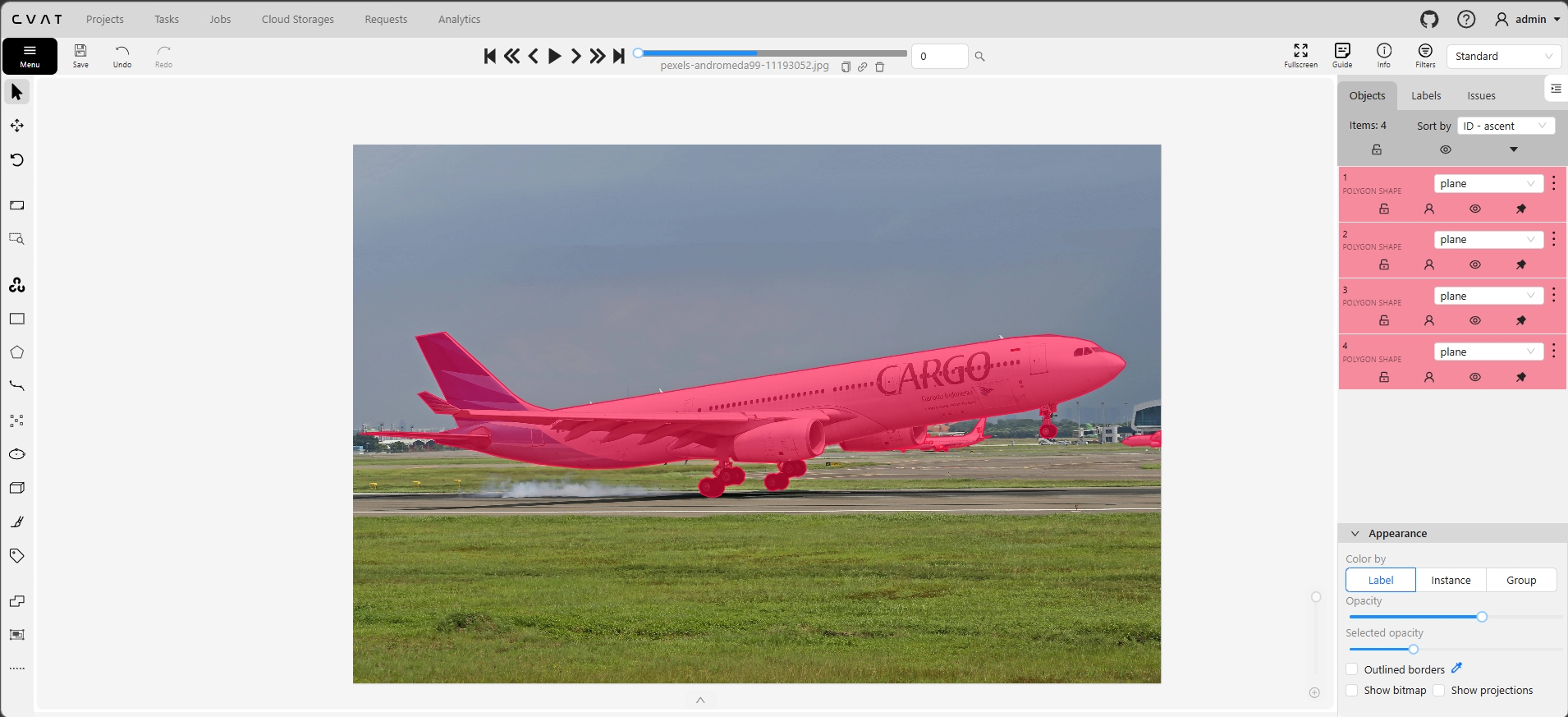
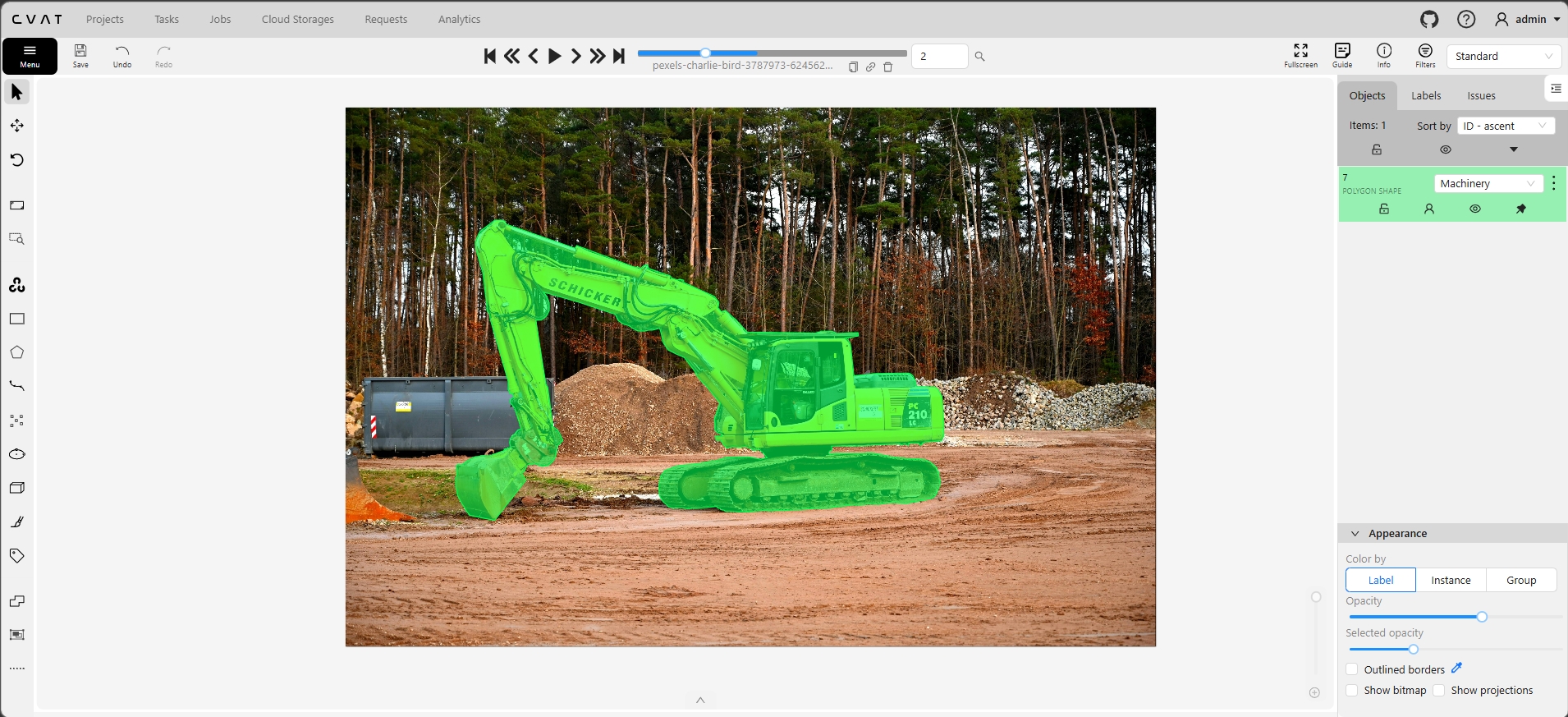
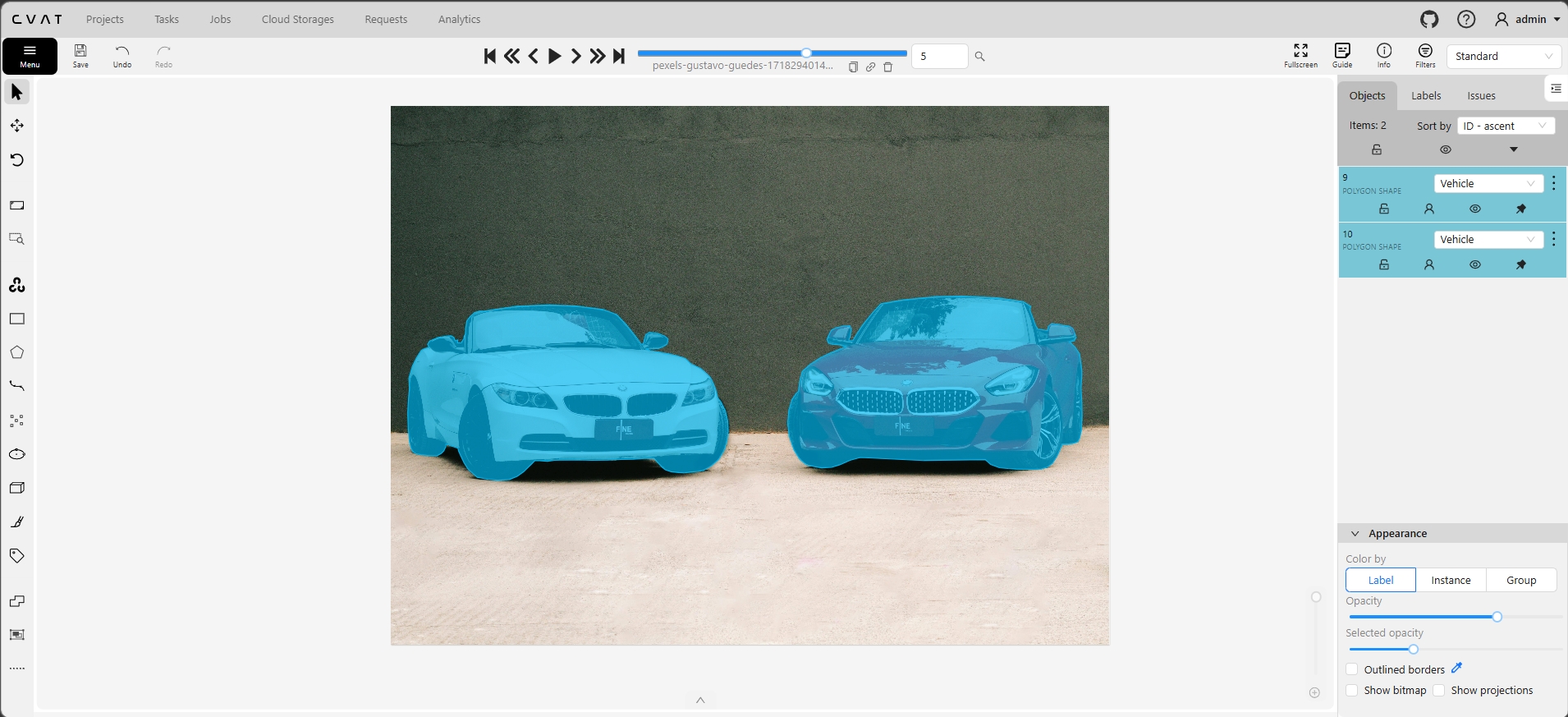
Pixel-precise polygon boundaries traced around individual object instances. Each polygon captures the exact contour of the object with class-specific color coding. Objects panel shows instance-level label assignments.
Why Instance Segmentation Matters
Beyond Bounding Boxes
A bounding box around a car includes the road beneath it, the sky above it, and parts of adjacent vehicles. For applications like automated inspection, robotic manipulation, or autonomous navigation, this background noise in training labels degrades model precision. Polygon segmentation eliminates it — the model learns exactly where the object is, pixel by pixel.
Instance vs. Semantic
Semantic segmentation labels every pixel with a class but doesn’t distinguish between individual objects. Instance segmentation goes further — each object gets its own unique polygon, even when multiple objects of the same class overlap. This is essential for counting, tracking, and understanding spatial relationships between objects.
Industrial Applications
Manufacturing quality control, component inspection, defect detection, and robotic pick-and-place all require precise object boundaries. A polygon that’s off by even a few pixels can mean the difference between a correctly identified defect and a false negative in a production line.
Automotive Applications
Lane boundaries, vehicle silhouettes, pedestrian contours, and road surface segmentation all demand polygon-level precision. Autonomous driving perception models trained on polygon annotations consistently outperform those trained on bounding boxes for tasks requiring spatial understanding.
Key insight: Polygon segmentation is 3–5x slower than bounding box annotation per image. Every vertex must be placed precisely, complex shapes require hundreds of points, and overlapping instances need careful separation. This is why it commands premium pricing — and why quality control is critical. A single sloppy polygon can corrupt an entire training batch.
How We Delivered This Project
Annotation Workflow
- Guidelines review: Client annotation specifications reviewed — class definitions, boundary rules, overlap handling, and edge case protocols
- Task setup: 1,000 images uploaded to self-hosted CVAT, batched for parallel annotation
- Polygon tracing: Annotators trace precise object boundaries using CVAT’s polygon tool, placing vertices along the object contour
- Instance separation: Overlapping objects receive separate polygons with distinct instance IDs
- Boundary refinement: Zoom-level vertex adjustment for pixel-precise boundaries on complex shapes
Quality Assurance
- Stage 1 — Self-check: Annotator zooms to 200%+ and reviews every polygon boundary for precision
- Stage 2 — Peer review: Second annotator validates boundary tightness, instance separation, and class accuracy
- Stage 3 — QA Lead final: Ibrahim Ouma performs final validation with focus on complex overlapping instances and edge cases
- Boundary precision: Polygon edges must follow the object contour within 2–3 pixels
- Completeness: Every visible object instance annotated — no missed instances
- Overall QA target: 98.5% accuracy across all annotations
Who This Serves
Polygon instance segmentation supports teams building:
- Autonomous vehicles: Precise vehicle, pedestrian, and lane segmentation for perception models
- Industrial inspection: Component boundary detection for automated quality control
- Manufacturing: Defect localization and part segmentation for robotic assembly
- Medical imaging: Organ and lesion boundary delineation (transferable methodology)
- Robotics: Object boundary understanding for precise grasping and manipulation
NDA-protected delivery: This project was delivered under subcontract with full NDA protection. Client identity, specific object classes, and detailed dataset characteristics are confidential. The screenshots and methodology shown here demonstrate our polygon segmentation capability without exposing protected information.
Need Polygon Segmentation?
Pixel-precise instance segmentation for industrial, automotive, or any domain. Start with a free pilot — same CVAT infrastructure, same QA pipeline, same 98.5% accuracy guarantee.